OffRoad Drive Pro
- 3.3
- Rating
- 10.00K
- Installs
- $2.99
- Price

 Analysis by App-foxy
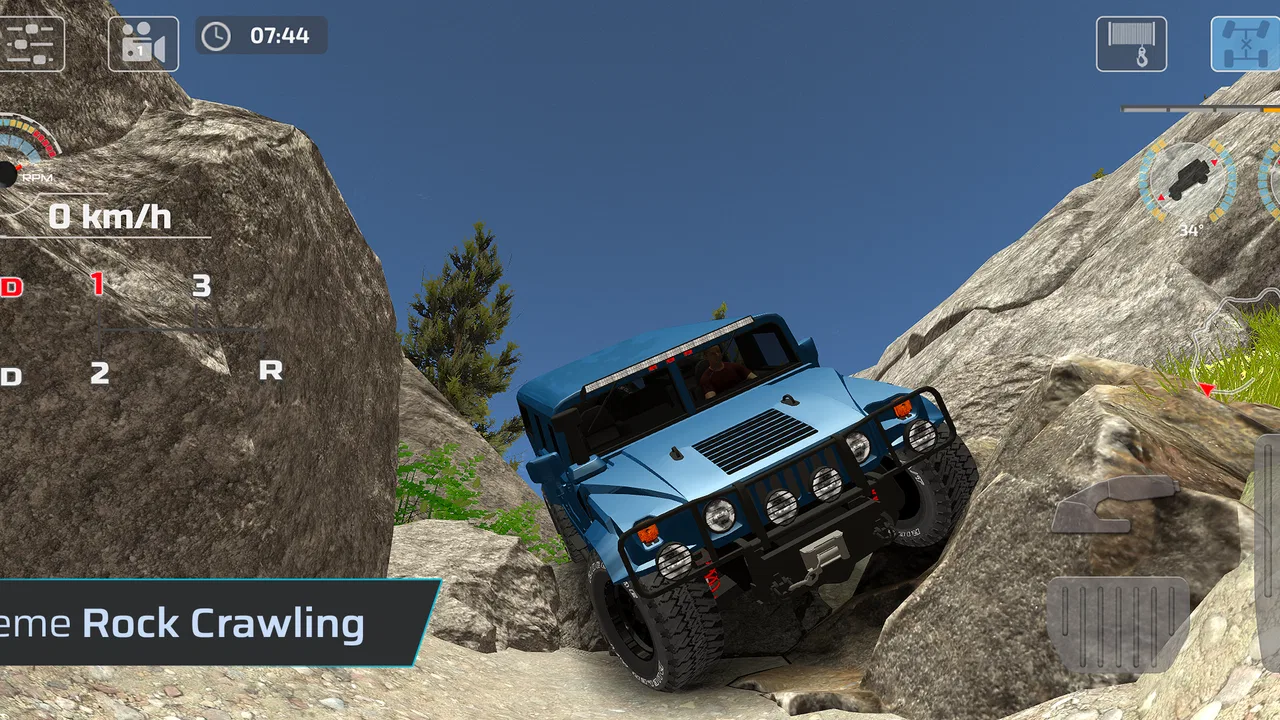
OffRoad Drive Pro is the kind of racing game I would recommend to someone who enjoys the slow, deliberate side of driving rather than constant speed. From my time with it, the appeal comes from treating rough ground as a problem to solve: suspension movement, traction, and the use of a differential lock matter more than simply pointing the vehicle toward the finish. It is made by LogicMiracle, and its focus is narrow but clear. This is an off-road driving experience for players who want to feel the terrain working against the vehicle.
That focus is also the reason I would not suggest it to every racing fan. If you mainly want polished circuit races, dramatic overtakes, or a large collection of licensed cars, this will feel limited. If you like experimenting with control, choosing a careful line, and recovering from a bad approach, it has a more interesting personality than its compact presentation first suggests. The game costs $2.99, so the decision is less about tolerating a free download and more about deciding whether this particular driving style is worth paying for.
Why the off-road handling is the main attraction
The strongest part of the experience is the way it asks me to think about movement instead of treating the vehicle as a simple racing token. A steep section is not automatically solved by holding the accelerator. I have to consider how the vehicle is sitting, whether one side is losing grip, and whether maintaining momentum is safer than stopping. That makes even a short drive feel more involved than a typical arcade race.
You May Also Like

 Blood Strike: 2.5 Anniversary
Blood Strike’s Loadouts Turn Every Drop Into a Tactical Gamble
A close look at Blood Strike’s custom loadouts: how fast access to signature weapons reshapes its battle royale rhythm, rewards preparation, and narrows the gap between fights.

 Pandora - Music & Podcasts
Pandora’s Music Is Easy to Start, but Harder to Recover
Pandora’s strength is its low-effort path from a seed to a station. Its weak spot is how much confidence it asks you to place in connection, setup, and quiet recovery.

 8 Ball Pool
 Is Built on Rivalries, Rematches, and Routine
A close look at the rivalries, rematches, shared routines, and unanswered safety questions that turn a quick pool match into a persistent mobile community.

 Samsung Music
’s Quiet Strength Is Playing What You Already Own
Its reach comes less from spectacle than from dependable access to a personal library. That simplicity is both the app’s strongest retention engine and its ceiling.

 AccuWeather: Weather Radar
AccuWeather Review: A Quick, Clear Forecast for Everyday Decisions
For everyday plans, the best forecast is the one you can understand quickly. AccuWeather makes rain timing, radar, and local conditions easy to act on, with a few trade-offs.

 Hill Climb Racing
Why Hill Climb Racing Still Turns Crashes Into One More Run
A tiny car, a bumpy hill and one more upgrade: Hill Climb Racing keeps resurfacing because its simple chaos makes every near-miss feel personal.
More From Our News Desk
View All News


The realistic suspension emphasis is important here. I notice it most when the vehicle crosses uneven ground and the body responds rather than remaining perfectly flat. That response gives the terrain a physical presence. It also changes how I approach obstacles: a line that looks direct may produce a poor angle, while a slower route can keep the vehicle balanced and moving.
The differential-lock feature is the other major reason to pay attention. It is not just a decorative button for the interface. Used at the right moment, it helps when the wheels are not turning at the same rate on loose or uneven ground. I found it more useful as a recovery and traction tool than as something to leave active constantly. Learning when to engage it becomes part of the driving rhythm.
The best moments come from managing traction, not chasing top speed. That distinction separates this game from many casual racing titles. A careful player can enjoy a satisfying sense of control even when the route itself is not especially elaborate. The reward is the clean climb, the controlled descent, or the successful escape from a section where the vehicle initially seems stuck.
Small driving decisions matter more than quick reactions
I would describe the controls as more thoughtful than twitchy. The game is at its best when I make small steering corrections and avoid treating the accelerator like an on-off switch. Holding too much power while the vehicle is badly positioned can make a difficult section worse. Easing off, changing the angle, and trying again often works better than forcing the vehicle forward.
That approach gives the game a useful learning curve. A newcomer can begin by driving instinctively, but improvement comes from noticing why a maneuver failed. Was the entry angle too sharp? Did I use the differential lock too late? Did I stop on a surface where restarting would be difficult? Those questions make repeated attempts feel purposeful rather than random.
One practical tip is to treat momentum as something to preserve selectively. On a mild incline, slowing down too much can leave the vehicle without enough movement to continue. On a broken or sharply angled section, however, speed can make the suspension react more violently and send the vehicle into a worse position. I get better results by approaching uncertain ground with enough movement to remain mobile, but not so much that I lose the ability to correct.
Another useful habit is to use the differential lock as part of a plan rather than a permanent setting. When the vehicle is already moving cleanly, leaving it alone keeps the drive simpler. When traction becomes uneven, activating it can help the wheels work together. Turning it on before a difficult patch is often more effective than waiting until the vehicle has already lost momentum.
What makes it different from ordinary racing games
Compared with a standard arcade racer, OffRoad Drive Pro is less interested in spectacle. There is no need to memorize braking points for a smooth circuit or to build a race around overtaking opponents. The challenge is more personal: can I read the ground, keep the vehicle composed, and complete the route without making one careless input turn into a recovery problem?
That makes it closer to a focused driving simulation than to a conventional mobile racing game. I appreciate that difference, especially when I want a short session that still requires attention. The game does not feel like something I can play well while barely looking at the screen. Its systems are simple enough to understand, but they ask me to stay involved.
The trade-off is variety. A larger racing alternative will usually offer more vehicles, more event types, stronger visual presentation, or a wider sense of progression. OffRoad Drive Pro has a narrower purpose. Its value depends on whether suspension behavior and differential control are enough to keep me interested. For players who want constant new rewards, that focused design may become repetitive sooner.
A realistic way to use it in everyday play
I found it most suitable for a short break when I want something more engaging than a quick reflex game. Imagine having a few minutes before an appointment: I can start a drive, concentrate on a difficult stretch, and stop after a meaningful attempt rather than needing to complete a long campaign. The slower pace also makes it a reasonable choice for playing with sound reduced, since the important feedback comes from the vehicle’s movement and my visual reading of the terrain.
It is also a good fit for players who like replaying a section to improve technique. Instead of asking only whether I finished, I can set a personal goal: use less correction, avoid getting stuck, approach a slope with better balance, or rely on the differential lock more intelligently. That self-directed challenge gives the game more staying power than a quick glance at the store summary might suggest.
On the other hand, I would skip it for a commute if I wanted an immediately exciting race with obvious action. The measured handling means that the game can feel quiet at first. It rewards patience, and a player looking for instant acceleration may mistake that patience for a lack of energy. The game’s identity is built around control, not adrenaline.
Where the experience falls short
The biggest weakness is that the focused driving model needs enough environmental and gameplay variety to support it. Realistic suspension and differential control are interesting, but they cannot carry the entire experience forever without fresh reasons to return. I enjoyed learning the handling, yet I can also see some players reaching a point where the basic activity feels familiar.
The presentation is functional rather than lavish. That is not automatically a problem, because the handling is the main attraction, but it does affect the sense of occasion. Compared with premium racing games that surround each event with elaborate menus, dramatic camera work, and a strong progression structure, this feels more like a dedicated driving sandbox. I prefer that directness, although players expecting a large production may find it modest.
The controls can also expose their own tension. Precision is rewarding when the vehicle responds the way I expect, but small mistakes matter. A player may understand the correct idea and still need several attempts to execute it. That friction is part of the challenge, yet it can become frustrating when I am trying to make a quick, casual run rather than practice a route.
There is a particular trade-off between realism and convenience here. A more forgiving game would let me recover quickly and keep the session flowing. This one makes recovery part of the driving problem, which gives successful corrections more value but also makes failure more disruptive. I would advise new players to begin with a patient mindset instead of judging the game after an awkward first attempt.
The current version is 0.95, which places the game in a stage where I would approach it as a focused experience rather than a fully expansive racing package. I would not buy it expecting the breadth of a long-established franchise. I would buy it because the central off-road handling idea is appealing enough to explore on its own.
Who should install it, and who should pass
This is best for someone who enjoys off-road driving, vehicle behavior, and small technical decisions. You will probably get the most from it if you like games where improvement comes from understanding a system instead of unlocking a stronger vehicle and overpowering the challenge. It is particularly suitable for patient players who enjoy retrying a difficult section with a different line or a better use of traction control.
It may also suit a racing fan who is tired of every mobile title pushing toward faster laps. The game offers a change of pace. I can focus on terrain, balance, and recovery without feeling pressured to perform a series of perfect overtakes. That makes it a useful companion to a more traditional racing game rather than a direct replacement for one.
I would be cautious about recommending it to children who want immediate, uncomplicated play, even though its content rating is Everyone. The age rating makes it broadly accessible, but the handling still requires patience and experimentation. A younger player may enjoy the vehicle movement, while another may find the slower problem-solving less exciting than a simple arcade racer.
Players with older compatible devices have a reasonably broad starting point, since the game requires Android 6.0 or later. That does not tell me how every device will perform, so I would still keep expectations sensible on older hardware. The important purchasing question remains the same: do you want a compact off-road driving game, or are you looking for a broad racing collection?
The public response is mixed, with an average of 3.3 from around 257 ratings and 23 written reviews. I read that as a sign that the game’s appeal is specific rather than universal. It has reached over 10 thousand installs, enough to show that the idea has found an audience, but not so many that I would assume it offers the polish or scale of the biggest names in mobile racing.
How I would approach the first sessions
My advice is to spend the opening session learning the vehicle instead of trying to rush through every section. Test how much steering correction is needed, observe how the suspension reacts to an uneven approach, and notice the difference between maintaining momentum and forcing acceleration. This makes later attempts less frustrating because I am building a mental model of the vehicle rather than simply repeating the same mistake.
I would also avoid activating every assistance or traction-related input automatically. The differential lock is most satisfying when I use it to solve a specific loss of grip. If I rely on it without understanding the situation, I lose the chance to learn what the terrain is asking me to do. The game becomes more manageable once each control has a clear purpose.
For a relaxed session, I would choose one objective at a time. Completing a route is one goal; completing it without a recovery is another. Trying to improve everything at once can make the driving feel more difficult than it needs to be. Separating those goals lets me appreciate the handling even when a run is not perfect.
That method also answers the practical question of whether the game is suitable for short play. Yes, provided I accept that a short session may be about learning rather than winning. A few minutes can be worthwhile if I finish with a better understanding of one obstacle. It is less satisfying when I expect every launch to deliver a complete, dramatic race.
My verdict on the purchase
OffRoad Drive Pro succeeds because it commits to a clear idea: off-road racing should be about managing a vehicle over difficult ground, not merely driving quickly on a different-looking track. The suspension behavior and differential-lock mechanic give that idea substance. I enjoyed the moments when careful steering and controlled momentum turned an awkward section into a clean passage.
At the same time, the game asks the player to accept a limited scope. It is not the right choice for someone searching for a huge garage, a cinematic racing presentation, or nonstop competition. The slower rhythm can feel demanding, and the focused formula may not provide enough variety for players who need constant progression.
At $2.99, I see it as a specialist purchase. I would recommend it to a friend who already knows that realistic off-road handling sounds more appealing than another arcade racer. I would tell a casual racing fan to choose a broader alternative instead, especially if variety and instant excitement matter more than traction management.
My final view is positive but selective. LogicMiracle has built a game with a recognizable driving character, and the best parts are genuinely more thoughtful than the short description suggests. If you approach it as a compact technical driving challenge, it can be satisfying. If you approach it as a complete mobile racing universe, it will probably feel too narrow. For the right player, that narrowness is not a flaw; it is the reason to play.
FAQs for OffRoad Drive Pro
01What is OffRoad Drive Pro?
OffRoad Drive Pro is an off-road driving simulation game focused on exploring difficult terrain rather than following ordinary race tracks. Players can drive through mud, rocks, steep slopes, forests, and other challenging environments while attempting to control different vehicles. The game emphasizes careful driving, vehicle handling, and overcoming obstacles, making it more suitable for simulation fans than for players looking for a simple arcade racer.
02Does OffRoad Drive Pro work offline?
OffRoad Drive Pro can generally be played without a constant internet connection, which makes it convenient for travel or areas with limited connectivity. However, some features may depend on the version installed, including advertisements, updates, store content, or other online services. It is a good idea to launch the game once while connected to the internet and check its menus before relying on it for completely offline play.
03What kind of vehicles and environments are available?
The game offers off-road vehicles designed to handle demanding landscapes, with gameplay built around climbing, balancing, and maintaining control on uneven ground. Depending on the version and unlocked content, players may encounter several vehicle options and environments such as muddy paths, rocky trails, hills, and forest areas. Progression may be required before every vehicle, level, or challenge becomes available.
04Is OffRoad Drive Pro difficult for beginners?
OffRoad Drive Pro may feel challenging at first because vehicles can lose traction, tip over, or become stuck when you accelerate too aggressively. Beginners should learn to use the controls gradually, choose suitable routes, and approach slopes and obstacles at a controlled speed. The game rewards patience more than constant acceleration, so players familiar with realistic driving simulations will probably adapt more quickly.
05Is OffRoad Drive Pro free to download and safe to install?
The availability and pricing of OffRoad Drive Pro can vary depending on the Android or iOS store, region, and current developer settings. Before installing, check the official store listing for the latest information about price, advertisements, in-app purchases, device compatibility, and required permissions. Downloading from an official marketplace is the safest option because unofficial APK or modified versions may contain harmful software or fail to work correctly.
Pros
- Realistic off-road physics make every climb
- turn
- and descent feel challenging.
- Wide range of 4x4 vehicles offers different handling styles and capabilities.
- Open environments encourage exploration beyond the main driving routes.
- Winch mechanics add useful recovery options when vehicles get stuck.
- Offline play lets you drive without a constant internet connection.
Cons
- Steep learning curve can make early challenges frustrating for new players.
- Vehicle upgrades and progression may require considerable time to unlock.
- Graphics look dated on newer phones compared with modern driving games.
- Controls can feel imprecise during tight turns and difficult terrain.
- Some devices may experience frame-rate drops in larger outdoor areas.

OffRoad Drive Pro
Gallery